
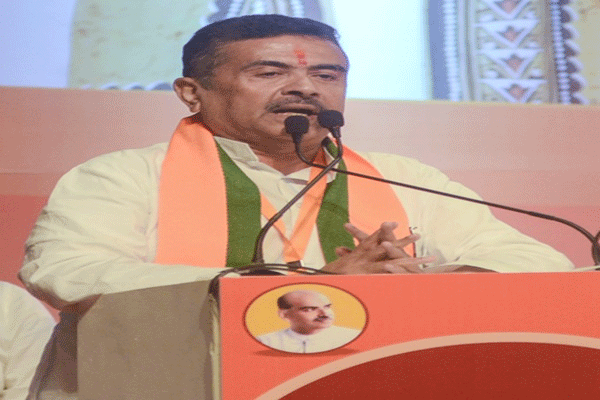
Bengal’s political landscape witnesses a seismic shift as Suvendu Adhikari, the newly-elected Chief Minister, declares a historic dawn for West Bengal. His remarks on Saturday signal the end of an era of alleged misrule and the advent of a ‘double-engine’ government focusing on development and governance.
Adhikari announced that Saturday marks the beginning of ‘Sonar Bangla’—a vision for a prosperous Bengal. He described his administration’s goal as fostering ‘peace and prosperity’ for all citizens. With anticipation high, Prime Minister Narendra Modi prepares to visit Kolkata for the inaugural oath-taking ceremony at Brigade Parade Ground, underscoring this pivotal moment in Bengal’s history.
In a message shared on X, Adhikari extended a warm welcome to Prime Minister Modi, emphasizing the significance of the ceremony. He stated, “It is a moment of profound pride and jubilation to welcome visionary Leader PM Narendra Modi Ji to the City of Joy. Today, as we witness the swearing-in ceremony of the first-ever BJP government in West Bengal since Independence, we fulfil the dreams of our founding fathers.”
The BJP’s governance marks a critical transition for the state, which has long been associated with political turbulence and governance challenges. With Adhikari at the helm, the newly elected leaders aim to shift the narrative towards inclusive governance, economic rejuvenation, and infrastructural advancements across West Bengal.
Political analysts view this moment as a culmination of the party’s efforts to penetrate the traditionally stronghold of the Trinamool Congress (TMC). The BJP has campaigned vigorously over the last few years, promising a shift from corruption to transparency and accountability in public administration.
This transition could lead to numerous reforms in various sectors including education, healthcare, and industrial growth within the state. As Adhikari’s administration prepares to implement its vision, stakeholders from business, education, and civil society are poised to contribute to the new governance model.
As Bengal stands on the brink of this ‘double-engine’ governance, citizens express mixed emotions. While many hold high hopes for tangible changes, others remain skeptical, citing past promises made by various governments. Yet, the palpable enthusiasm surrounding the new administration reflects a significant desire for change among the populace.
In conclusion, West Bengal enters a new chapter under BJP leadership, as Suvendu Adhikari urges the people to come together for a brighter future. With local elections just around the corner, the BJP’s commitment to its manifesto will be crucial in shaping the state’s political dynamics in the years to come.
