
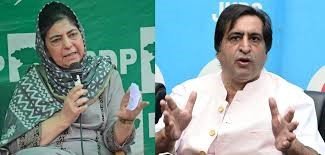
Peoples’ Democratic Party leader Mehbooba Mufti and Peoples’ Conference chief Sajjad Lone reported being placed under house arrest on Thursday. This move is to allegedly prevent them from attending the funeral of notable political figure Professor Abdul Gani Bhat in Sopore.
Mufti stated, “The decision to place the political leadership under house arrest today, simply to stop us from visiting Sopore to offer condolences on the demise of Professor Abdul Gani Bhat, lays bare the harsh and undemocratic reality in Jammu and Kashmir.” This statement was shared via her post on social media platform X.
What Happened to Abdul Gani Bhat?
Professor Abdul Gani Bhat, a respected leader in the Hurriyat Conference, passed away at home on Wednesday evening following a prolonged illness. His death has sparked significant reactions among the political landscape in Jammu and Kashmir.
In her remarks, Mufti connected Bhat’s death to unresolved public sentiments in the region. She cited the recent controversies surrounding the Hazratbal Shrine, saying, “What unfolded at Hazratbal Dargah—the eruption of spontaneous, raw public anger—was not just an isolated incident. It was a loud, unmistakable message from a people pushed to the edge.”
Controversy Surrounding Hazratbal Shrine
The Hazratbal Shrine has been at the center of a heated controversy since September 5 when a plaque featuring the Ashoka emblem was vandalized. This incident led to many political parties, including Mufti’s, accusing Waqf Board chairperson Darakshan Andrabi of provoking religious sentiments.
Mufti emphasized that the BJP government appears to lack interest in fostering peace in Kashmir. “Instead, they seem determined to keep the region in a constant state of turmoil,” she expressed, reflecting on the ongoing political unrest.
Political Reactions and Implications
In addition to Mufti’s claims, Sajjad Lone also voiced his frustration, stating that he was restricted from traveling to Sopore. “I have been put under house arrest in order to prevent me from visiting Botingoo, the ancestral village of Professor Ghani sahib,” he said. “I fail to understand what is the need for this.”
For many observers, these developments highlight the tension between political leaders in Jammu and Kashmir and the central government. Experts suggest that such restrictions may further alienate the region’s populace, stirring up political and social unrest.
Public Sentiment and Future Prospects
As tensions rise, the public’s emotional response to the recent events signals deep-rooted sentiments. Activists argue these frustrations are not merely reactions to individual events but represent a growing discontent over political decisions and governance in the region.
According to local experts, the political climate may remain volatile unless significant measures are taken to address the concerns of the people. Public sentiment is rapidly shifting, and ignoring these underlying issues could further destabilize the area.
In conclusion, both Mehbooba Mufti and Sajjad Lone’s house arrests raise critical questions regarding political freedom and governance in Jammu and Kashmir. As they navigate this treacherous political landscape, it becomes increasingly vital to consider the voices of the people, who yearn for peace, security, and justice.
