

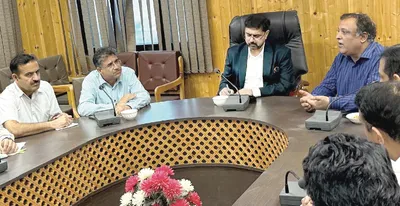
During a surprise visit today, Jammu & Kashmir Minister Satish Sharma urged officials to explore innovative solar energy solutions. This push aligns with the government’s goal of harnessing renewable energy for sustainable growth.
What Does Satellite Sharma Envision for Solar Energy?
Sharma visited the ‘Tawanai Ghar’ at Bemina to assess its operations. He emphasized the need for practical solutions that can be implemented across Jammu and Kashmir. “The Government is committed to making Jammu & Kashmir a model in renewable energy adoption,” he stated.
His visit highlights the region’s vast potential for solar energy, and he directed the department to develop concrete proposals focusing on broader adoption. This includes increasing solar installations in government buildings, public institutions, and utilities.
Mission Solar Energy: A Path to Self-Reliance
Under the Mission Solar Energy initiative, launched by the Chief Minister, achieving self-reliance in renewable energy is paramount. Sharma underscored that collaborative efforts among stakeholders are essential.
To promote household adoption, incentives will be introduced, and partnerships will be formed with research institutions and private stakeholders to innovate cost-effective solutions. “Timely completion of ongoing renewable energy projects is crucial,” Sharma added.
In his visit, Sharma also addressed employee concerns within the Science & Technology department. He underlined the importance of a supportive work environment, asserting that efficiency and productivity are tied to employee welfare.
Why is Solar Energy Important for Jammu & Kashmir?
Solar energy adoption is essential for reducing reliance on conventional power sources and protecting Jammu & Kashmir’s fragile ecology. Sharma highlighted that the government is focused on sustainable growth through renewable energy, which will not only meet energy demands but also preserve the region’s natural resources.
“We must work with renewed zeal and accountability,” Sharma urged, rallying government officials to transform J&K into a clean energy hub.
Impact of Innovative Solar Solutions on Local Communities
By investing in solar energy solutions, local communities can experience significant benefits. Increased solar power installation can lead to job creation, improved energy security, and lower electricity costs for households.
In fact, statistics show that transitioning to renewable energy sources like solar can create up to 24 jobs per megawatt of solar power. This not only boosts the economy but also helps combat climate change.
The CEO of JAKEDA, P.R. Dhar, and other senior officers from the Science and Technology Department were present, indicating that this initiative has considerable backing.
Conclusion: A New Era for Jammu & Kashmir’s Energy Sector
Satish Sharma’s visit marks a significant step towards embracing solar energy in Jammu & Kashmir. By prioritizing innovation and collaboration among stakeholders, the region can harness its solar potential more effectively.
The commitment to renewable energy starts here, encouraging a bright and sustainable future. Sharma’s words serve as a reminder that the journey to becoming a clean energy powerhouse requires dedication and action from everyone involved.
