

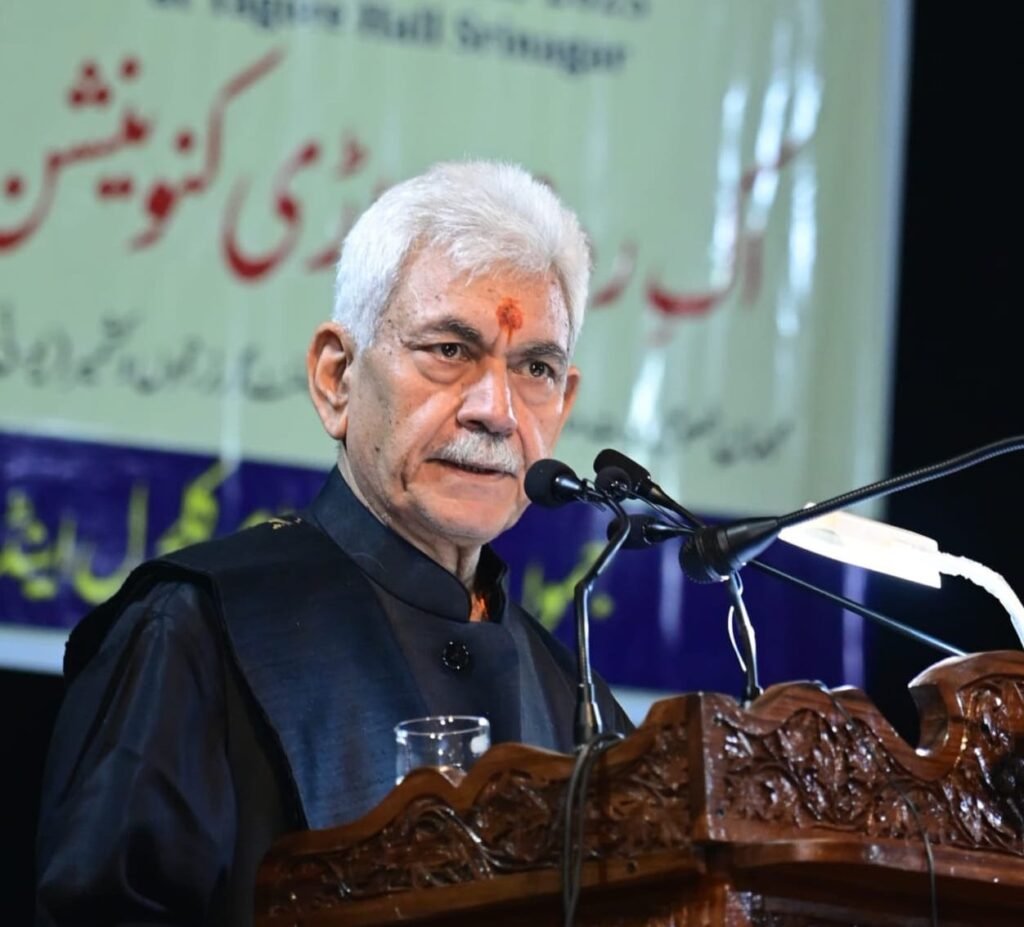
On Saturday, Lieutenant Governor Manoj Sinha underscored the vital role of the people in combating terrorism in Jammu and Kashmir during an event in the Union Territory. He stated that while the government and security forces work diligently, the community must also take responsibility for ending terrorism.
Addressing attendees, Sinha noted a significant decline in terrorist activities across India. He pointed out that terrorism is now largely contained to specific regions and highlighted the success in reducing violence, particularly in the North-East, which he described as almost terror-free.
“Terrorism has receded in various parts of the country. The North-East is largely terror-free now. Left-wing extremism or Naxalism remains constrained to a few districts, and I am confident it will be eradicated entirely in the coming months,” he asserted.
He acknowledged that areas in Karnataka, Kerala, and especially Jammu & Kashmir have grappled with terrorism for extended periods, emphasizing the urgent need to eliminate terror altogether.
“Terrorism is the greatest obstacle to development and job creation. While security forces and the administration are carrying out their duties, the people of Jammu and Kashmir also bear a responsibility. They should avoid actions that could inadvertently promote such activities, as these lead to significant issues,” he cautioned.
Sinha highlighted that conditions in Jammu and Kashmir have notably improved, stating that instances of street violence and stone-pelting have diminished significantly.
“Educational institutions, businesses, and colleges are now operating like those in other parts of the country. Furthermore, no prominent commander from any major terror group remains active, with only one local recruitment into terrorism reported this year,” he added.
The Lieutenant Governor did not shy away from addressing external factors, specifically referencing Pakistan’s ongoing support for terrorist activities. He outlined a series of achievements in stabilizing the region but lamented the challenges posed by the neighboring nation.
“We have a neighbor that continually engages in mischief rather than prioritizing national development post-partition. They attacked India and Jammu and Kashmir immediately after partition and have since lost four direct wars. Understanding that they cannot defeat India militarily, they now resort to proxy warfare by radicalizing individuals,” he elaborated.
Sinha underscored the grave human cost of the violence, saying, “Over 40,000 lives have been lost to terrorism. How much longer will this cycle of violence persist? While it is the government’s and security forces’ duty to combat this menace, it is also the responsibility of the people to take action.”
In a veiled reference to certain public figures, Sinha warned that some individuals echo sentiments similar to those of the terrorist organization, ‘The Resistance Front’ (TRF). He stressed the dangers of creating narratives that align with such groups.
“When statements mirror those made by the TRF in social media, it causes extensive harm. If we echo the same sentiments as those expressed by terror organizations, it is undeniably dangerous,” he concluded. Sinha’s statements highlight the intertwined responsibilities of the government, security forces, and the community in the fight against terrorism, emphasizing a united stance for peace and development in Jammu and Kashmir.
