
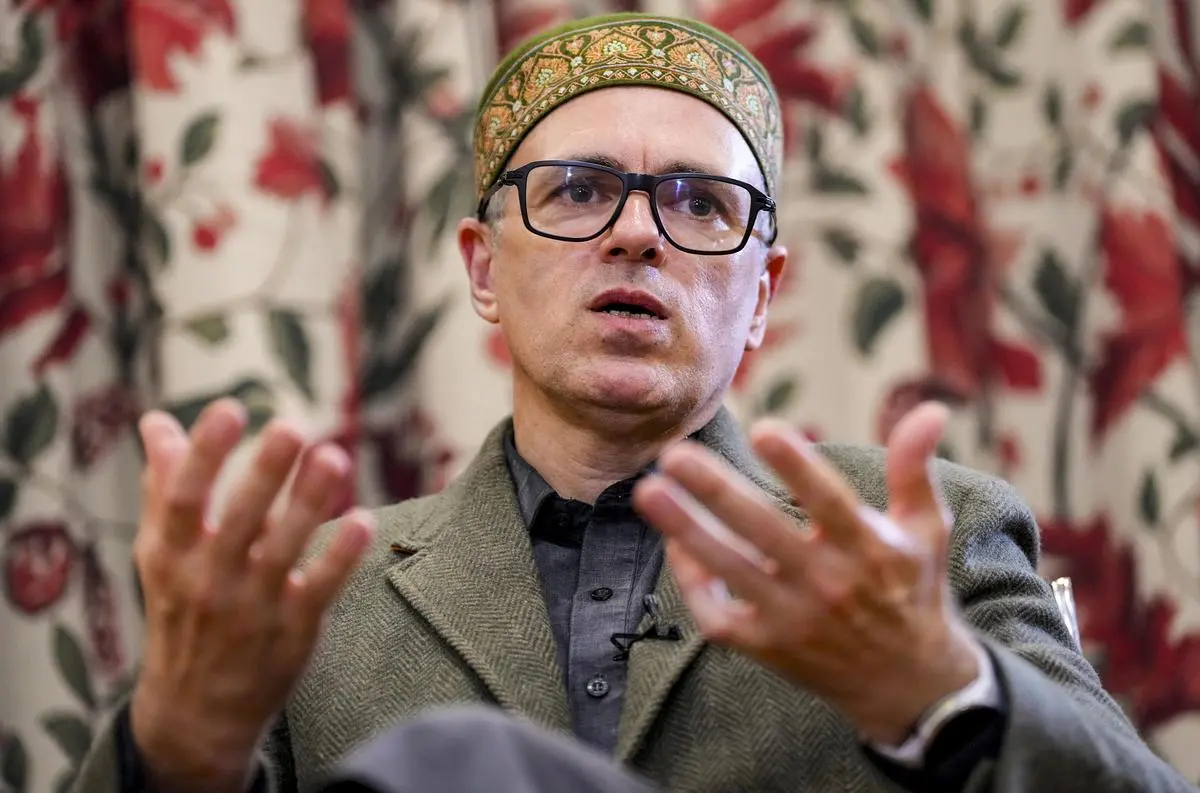
Jammu and Kashmir Chief Minister Omar Abdullah highlighted the imperative for the Tamil Nadu governor to allow TVK leader Vijay an opportunity to showcase his party’s majority in the assembly. Abdullah made these remarks on Friday following the governor’s decision to reject Vijay’s claim to form the government.
On Thursday, Tamil Nadu Governor Rajendra Vishwanath Arlekar denied Vijay’s request, asserting that the Tamilaga Vettri Kazhagam (TVK) does not possess the requisite numbers. The TVK, having fallen short of a simple majority needed to govern, stands at a significant crossroads in the state’s political landscape.
Currently, the Tamil Nadu Assembly comprises 234 members, and the TVK must secure a simple majority of 118 seats. Although the Congress party, with its five MLAs, has pledged support for the TVK, it still leaves Vijay’s party short in numbers.
Abdullah vehemently argued that there exists no justification for imposing President’s rule in Tamil Nadu. He referenced various Supreme Court judgments that emphasize the importance of inviting the single largest party to form the government before demonstrating its majority within the assembly.
“According to the Supreme Court ruling, there should be no imposition of President’s rule. In multiple instances, the court has explicitly stated that after elections, the single largest party must be invited to lead and allowed to prove their majority,” Abdullah stated when addressing the media about the ongoing political unease in Tamil Nadu.
He recalled the case of former Prime Minister A B Vajpayee, who briefly governed for 13 days without all necessary numbers. “The President of India invited him to form the government, and he governed for 13 days. But when he could not confirm his numbers, he resigned,” he said, underscoring the precedent for allowing political figures the chance to govern under similar circumstances.
There is growing consensus among political observers that state governance should be decided through democratic processes rather than executive overreach. Abdullah continued, stating that Tamil Nadu’s political framework must adhere to these principles of democracy. The Jammu and Kashmir CM urged that “Vijay should be allowed to form the government; then he must prove his majority in the assembly. Should he secure confidence, he remains; if not, resignation is warranted.”
Vijay’s aspirations to lead Tamil Nadu come amidst mixed reactions from the political landscape. While some advocate for his leadership and the TVK’s aspirations, others remain skeptical about the feasibility of a government transition amid the current numbers.
The unfolding political drama in Tamil Nadu raises critical questions about governance standards and the balance between state authority and democratic integrity. With the state assembly’s dynamics shifting, all eyes remain on how Vijay navigates this turbulent political environment in proving his majority.
