
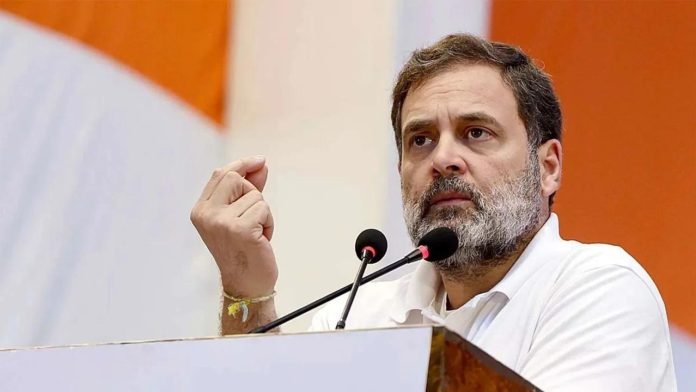
Congress leader Rahul Gandhi delivered a sharp critique of the ruling BJP on Wednesday, alleging that every sixth BJP Member of Parliament (MP) in the Lok Sabha won their seat through ‘vote chori’ or vote theft. Gandhi provocatively asked whether these MPs should be termed ‘ghuspethiya,’ echoing a term often used by the BJP to imply foreign intruders.
Gandhi’s claims come as a significant challenge to the legitimacy of BJP’s electoral victories. He stated, “Through vote theft, sometimes individual seats are stolen, and at other times, an entire government.” By his account, approximately 40 out of 240 BJP MPs achieved their position through dishonest means, which could heavily skew perceptions of the party’s mandate.
The former Congress president expressed serious concerns about the electoral system’s integrity. He noted, “If fair elections were to be held, they would not be able to win even 140 seats today.” This assertion raises questions about the BJP’s past electoral performance and the potential for future contests if a more equitable process is established.
Gandhi made these comments on X, the platform formerly known as Twitter, where he criticized the BJP’s hold over electoral institutions. He remarked, “They are not hard to identify – should we, in the BJP’s own parlance, label them ‘ghuspethiya’?” In this statement, he pointed out the pervasive influence that the BJP allegedly wields over institutions meant to safeguard electoral fairness.
His comments align with a growing discourse around election integrity in India. Observers note that Gandhi’s use of ‘vote chori’ taps directly into a wellspring of public dissatisfaction regarding the transparency of current electoral processes.
Furthering his argument, Gandhi criticized the BJP’s recent electoral successes in West Bengal and Assam, describing these victories as a “theft” of the people’s mandate. In his view, these outcomes represent a significant setback for Indian democracy, driven by political maneuvering rather than genuine public support.
“The theft of Assam and Bengal’s mandate is a big step forward by the BJP in its mission to destroy Indian democracy,” he stated, highlighting the potential long-term implications of such victories on the nation’s democratic framework.
Gandhi has also rallied behind the Trinamool Congress (TMC), which suffered significant losses to the BJP in the assembly polls. He urged those celebrating the TMC’s defeat to reconsider their stance, emphasizing that this political situation transcends party lines.
“Put petty politics aside. This is not about one party or another. This is about India,” he urged, calling for a more coherent and collective approach to safeguarding democracy.
The BJP’s recent victories, including its third consecutive term in Assam and the ousting of the TMC in West Bengal, have raised numerous questions about electoral fairness. Political analysts argue that the results in these states underscore a troubling narrative where allegations of ‘vote chori’ may persist, prompting essential discussions about electoral reform.
As the political landscape evolves, Gandhi’s remarks resonate with a growing segment of citizens concerned about electoral integrity. His vocal opposition to the BJP embodies a broader call for accountability among those in positions of political power.
In light of these developments, it remains to be seen how the BJP will respond to these allegations of vote theft and what measures it might take to reinforce its legitimacy in the coming elections. The scrutiny over electoral processes will likely intensify as the 2024 general elections approach.
